
Documented application
Agriculture & nutrient efficiency
Meta-analysis evidence covers crop productivity, phosphorus availability and nutrient-use efficiency across a large body of agricultural research.
New Zealand Woody Resource System
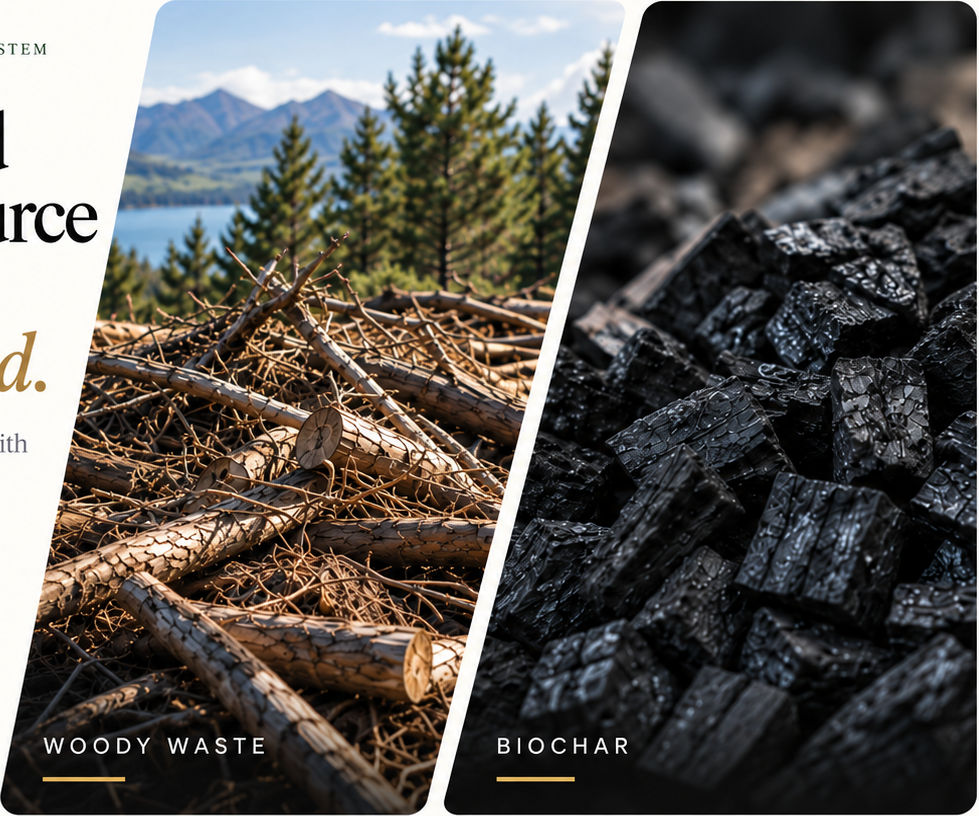
CharOne effectively converts woody waste through financially profitable recovery into a long-term source of biochar and energy for productive local use in the maintenance and sustenance of all arable land.
Turning woody waste into stable, carbon-rich biochar.
Cleaner land, lower risk, stronger communities.
01 / 07
The problem
2m+
hectares affected by wilding conifers
In 2024–25, wilding-conifer control activity covered more than 350,000 hectares under the national programme.
350k+
hectares
wilding-conifer control activity in 2024–25
MPI national programme reporting
NZ$19.2m
programme + partners
recorded wilding-conifer control investment in 2024–25
National programme and partner contributions
~3m
green tonnes / year
forest residues after commercial harvest
Scion estimate
02 / 07
The resource
Woody material source
Recovered biomass
Biochar & energy
Productive local use
Locally generatedMaterial comes from existing land management, forestry, horticulture, commercial activity and environmental events.
Prepared for useMaterial is sorted and prepared around quality, access, contamination, moisture and handling requirements.
Matched to local useThe output is matched to a defined local application rather than produced without an end use.
03 / 07
Biochar & value pathways
Product quality starts with feedstock selection, consistent production, testing and a defined end use.
14.45%
average crop-yield increase across 381 datasets
28.5%
average increase in available water capacity
37.1%
average reduction in nitrate leaching
>50%
lower urine-patch N₂O flux in one NZ field study
Documented application
Meta-analysis evidence covers crop productivity, phosphorus availability and nutrient-use efficiency across a large body of agricultural research.
Documented application
Pyrolysis produces biochar together with bio-oil and combustible gas. In engineered systems, these co-products are recovered for energy and process value.
Documented application
Meta-analysis evidence supports reduced bioavailability of selected heavy metals in contaminated soils using biochar systems designed for the contaminant and site.
Documented application
Systematic reviews document adsorption of selected pesticides and heavy metals using tailored biochar treatment systems.
Documented application
Peer-reviewed literature documents animal-feed applications, while EBC-Feed defines dedicated feed-grade quality requirements.
04 / 07
Evidence in practice
CASE 01
United States
Forest residues → biochar
What this demonstrates
Mobile and on-site systems convert low-value forest slash close to where it is generated.
Why it matters
A practical reference for source-near forest-residue conversion, handling and operating design.
CASE 02
Switzerland
Wood → heat, power & biochar
What this demonstrates
Frauenfeld integrates about 25,000 tonnes of wood chips with heat, electricity and biochar production.
Why it matters
A commercial-scale reference for connecting feedstock, useful heat, electricity and biochar in one plant.
CASE 03
Sweden
Advanced biomass gasification
What this demonstrates
GoBiGas demonstrated advanced biomass gasification, gas cleaning and methanation at demonstration scale.
Why it matters
A large-scale technical reference for converting biomass into upgraded gaseous energy products.
CASE 04
Finland
Biochar → mine-land restoration
What this demonstrates
Field trials recorded stronger grass biomass and lower uptake of selected metals under the studied conditions.
Why it matters
A field reference for biochar used with other amendments in degraded-land rehabilitation.
05 / 07
New Zealand pathways
Wilding-conifer control already produces material for logs and biofuel on workable sites.
New Zealand research documents substantial gorse biomass together with natural regeneration pathways, linking biomass management with the post-clearance land outcome.
Post-harvest forestry residues provide a large existing biomass stream for local biochar and energy applications.
CharOne places orchard pruning and biochar use in the same local land-resource loop; New Zealand horticulture has already field-tested biochar.
Biomass already supplies industrial process heat and some cogeneration in New Zealand, creating a direct local-energy pathway for woody resources.
06 / 07
How the system works
Volume, moisture, contamination, seasonality and conversion performance.
The landowner, operator or organisation managing the woody material.
Recovery, transport, processing and end-use value.
A clear application and user for the resulting material or energy.
The rules that apply to pest management, emissions, products, feed, water and land use.
A process matched to the material, scale and intended output.
What we have built
The system starts with real New Zealand woody-waste and land-management problems, identifies material for recovery, and connects that material with biochar, energy and other productive-use pathways.
It spans forestry, invasive vegetation, horticulture, commercial and community woody waste and environmental debris — with material quality and end use at the centre of the system.
Resource landscape
Multiple recurring woody-waste sources are connected through one recovery system.
Biochar & energy
Recovered biomass connects with biochar, energy co-products and other productive uses supported by product testing and standards.
Local applications
Outputs connect to agriculture, horticulture, land rehabilitation, local heat and other defined New Zealand uses.
The result is a practical resource system: reducing a woody-waste burden on one side while creating useful local value on the other.
Interested? Start a conversationGeneral enquiry
Start a conversation
CharOne works across woody waste, biomass recovery, biochar, land rehabilitation, local energy and productive resource applications.